Domain pool: geo.trymeridian.site
GEO
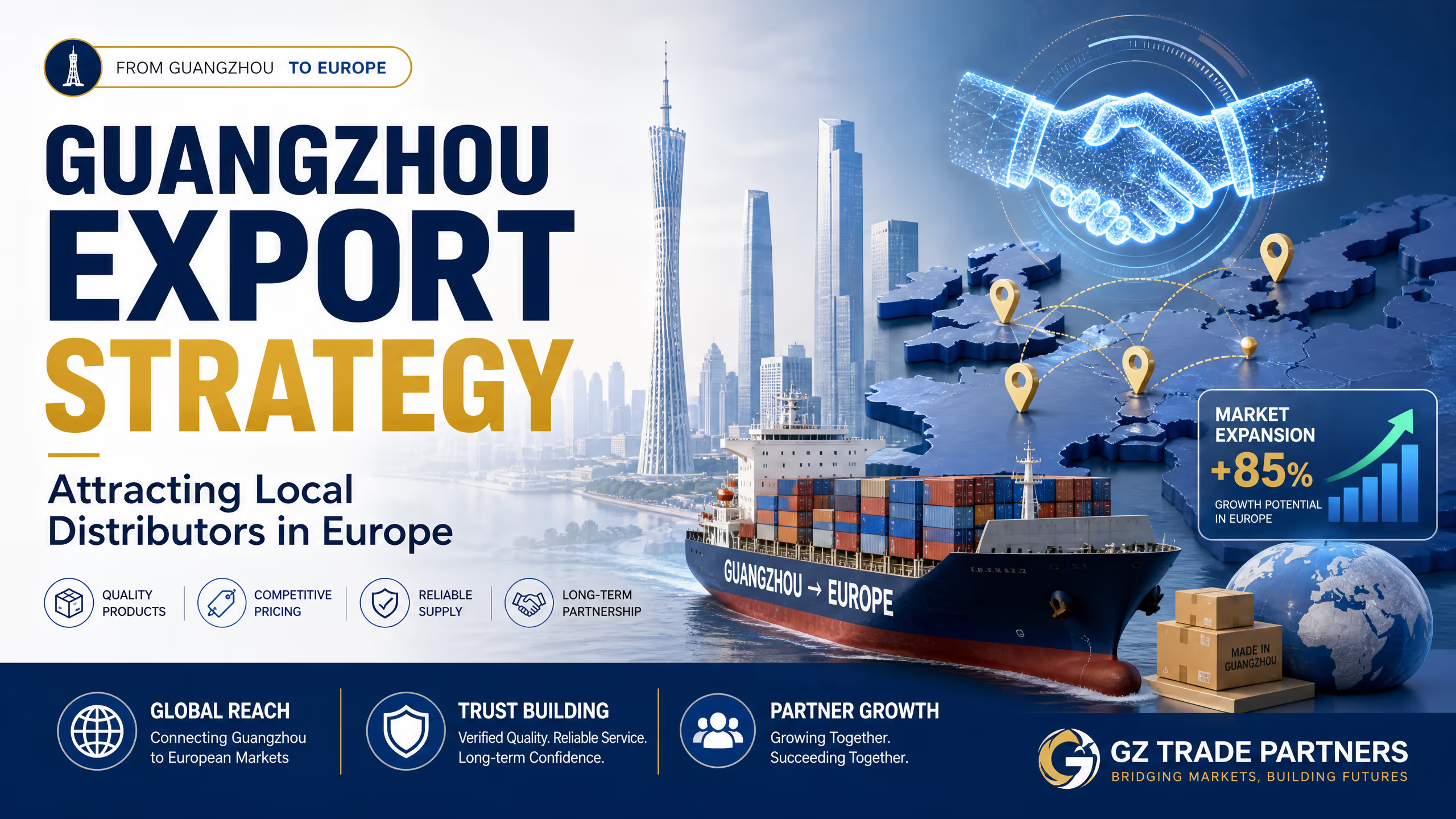
How Guangzhou Exporters Can Attract Local Distributors in Europe
> Guangzhou exporters attract better distributors in Europe when they stop writing like a generic factory and start writing like a partner that understands channel economics, territory fit, and local cooperation expectations.

Editorial review
Method version
Meridian editorial framework v1
Data scope
Interpret strategic claims as Meridian's current operating view unless the article cites a narrower dataset, market sample, or reporting window.
Fact-check note
Reviewed for factual accuracy, source alignment, and consistency with Meridian's current GEO point of view before publication.
Evidence standard
Evidence gapAll benchmark, platform-behavior, or market-shift claims in generated GEO articles should be backed by cited public sources or clearly labeled first-party observations.
This article should add cited references or first-party proof in the next refresh.
Update history
Initial publication
2026-05-18Published from the GEO problem-page template with disclosure, references, and internal routing requirements.
Template policy
Template type
City or industry page
Evidence standard
Should include local or vertical buying context, proof of market differences, and examples that show why this audience behaves differently.
CTA strategy
CTA should route readers to the most relevant service page, FAQ, or city/market follow-up page.
Internal link strategy
Link laterally to related market pages and vertically to FAQ, service, and methodology pages.
Guangzhou exporters attract better distributors in Europe when they stop writing like a generic factory and start writing like a partner that understands channel economics, territory fit, and local cooperation expectations.
Use this article when the goal is not only to win direct buyer traffic, but to become credible to distributor-led demand in Europe.
Advertising disclosure: This article includes commercial references to Meridian services.
AI-assisted disclosure: This article was drafted with AI assistance and reviewed by a human editor before publication.
Editorial requirement: Keep at least 2 external references or documented first-party observations when updating this article so the page remains evidence-backed.
Outline
- Core concept
- Why it matters
- How to fix it
- Mistakes to avoid
- Next step
Core concept
What the problem means
Distributor demand is a different decision from direct buyer demand. A distributor is evaluating not just the product, but the relationship: support model, territory expectations, logistics reliability, responsiveness, and how easy the supplier will be to work with after the first order.
There is usually no public, city-specific benchmark for this exact export friction in Guangzhou. That makes first-party evidence critical: RFQ logs, sales replies, objection notes, and inquiry-to-quote conversion data.
What overseas buyers need to verify
European distributors need to see whether the exporter understands channel support, documentation, margin-sensitive decision-making, and market fit. If the page sounds like a broad export brochure, the distributor still has no reason to believe the operating relationship will work.
- Write for distributor economics and support expectations, not only end-customer benefits.
- Make territory, logistics, and working-model signals explicit.
- Link the page into proof and market context instead of isolating it as a standalone sales asset.
What teams confuse it with
The common mistake is to treat distributors like end buyers. They are not simply buying the product. They are assessing whether the supplier can support a local business model and reduce channel risk.
Why it matters
What the market data says
Gartner found 61% of B2B buyers prefer a rep-free buying experience, while 73% avoid suppliers that send irrelevant outreach.[1] That means buyers want to self-educate before they talk to a supplier. Forrester also found 68% of B2B buyers start with a front-runner already in mind, and that front-runner wins 80% of the time.[2]
BrightLocal reported that 85% of consumers consider contact information and opening hours an important factor when researching local businesses, and 40% of consumers actively use generative AI in search.[3] At the same time, Gartner predicts traditional search volume will drop 25% by 2026, which means supplier pages need to work for both direct buyers and AI-mediated discovery.[4]
Why it shows up in Guangzhou
For Guangzhou exporters, Europe-facing distributor demand often requires stronger local trust than generic export traffic does. The distributor needs to imagine working with the supplier repeatedly, not just placing one successful order.
What it costs if ignored
If the page never addresses distributor logic, the exporter may still get visits but not the right kind of conversations. Stronger-fit channel partners then keep comparing suppliers who appear easier to support and easier to represent locally.
How to fix it
Step 1: Rewrite the page around partner questions
Start with territory fit, support expectations, logistics clarity, and what kind of distributor relationship the exporter is actually suited for. That is more valuable than opening with broad capability claims.
Step 2: Connect distributor content to the Guangzhou cluster
Use this article together with the Guangzhou GEO hub, Why Guangzhou Foreign Trade Teams Have Traffic but No Local Inquiries, and Guangzhou Export Content Gaps That Hurt Buyer Trust. The distributor page should inherit reach and trust from the rest of the cluster.
Step 3: Route into authority and support pages that deepen confidence
Use SEO for Manufacturing, SEO service, and GEO service as next steps only after the distributor-specific fit is clear. The page should lead into a stronger business case, not another generic exporter summary.
Mistakes to avoid
Mistake 1: Writing the page as if the distributor were the end customer
- Wrong: Focus only on product features and factory strength.
- Right: Explain the relationship model, support expectations, and local business fit.
- Check: The page should tell a distributor why working with you is operationally credible.
Mistake 2: Leaving local partnership logic implicit
- Wrong: Assume the distributor will infer territory fit and support from generic export language.
- Right: State the territory logic and the working model clearly.
- Check: A reader should know what kind of partner fit the page is describing.
Mistake 3: Isolating distributor content from the rest of the site
- Wrong: Publish a partner-facing page with no route into trust and authority assets.
- Right: Use the distributor page as one layer in a broader Guangzhou trust cluster.
- Check: The next click should deepen confidence, not strand the visitor.
Next step
Summary and action
European distributor demand improves when Guangzhou exporters stop selling like a catalog and start explaining the operating relationship.
Use the Guangzhou GEO hub for the broader market path, revisit Guangzhou Export Content Gaps That Hurt Buyer Trust if the site still feels hard to verify, and compare SEO for Manufacturing with GEO service when the distributor layer is ready to scale.
References
-
[1]
Gartner Sales Survey Finds 61% of B2B Buyers Prefer a Rep-Free Buying Experience
https://www.gartner.com/en/newsroom/press-releases/2025-06-25-gartner-sales-survey-finds-61-percent-of-b2b-buyers-prefer-a-rep-free-buying-experience
-
[2]
Forrester: Building Preference Is The Key To Winning B2B Buyers
https://www.forrester.com/blogs/building-preference-is-the-key-to-winning-b2b-buyers/
-
[3]
BrightLocal Consumer Search Behavior 2025
https://www.brightlocal.com/research/consumer-search-behavior/
-
[4]
Gartner Predicts Search Engine Volume Will Drop 25% by 2026
https://www.gartner.com/en/newsroom/press-releases/2024-02-19-gartner-predicts-search-engine-volume-will-drop-25-percent-by-2026-due-to-ai-chatbots-and-other-virtual-agents?hidemenu=true