Domain pool: geo.trymeridian.site
GEO
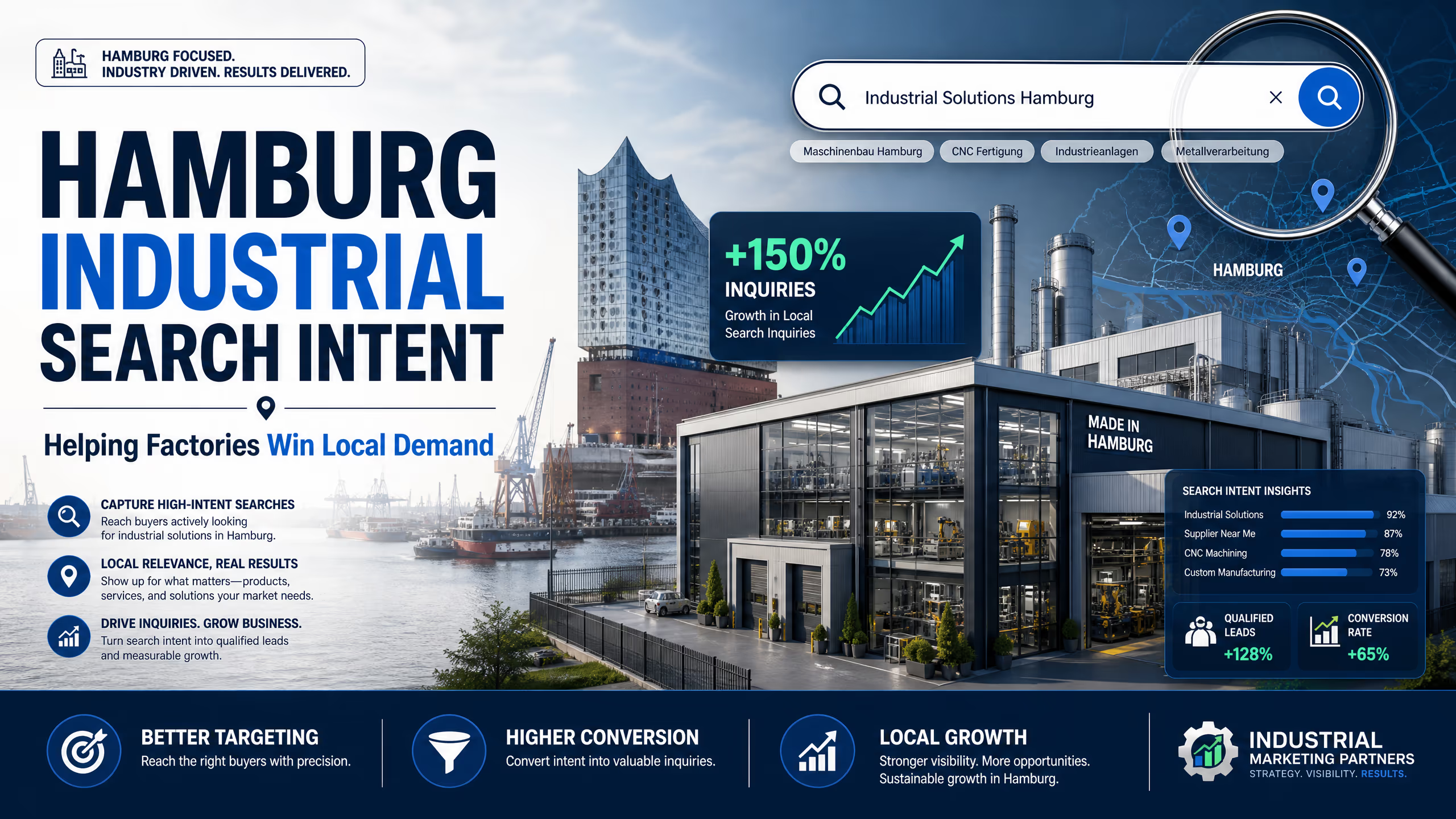
Hamburg Industrial Search Intent Pages That Help Factories Win Local Demand
> Hamburg industrial search-intent pages help factories win local demand when they answer one buyer risk clearly enough that the reader can move from initial search into serious evaluation without starting over elsewhere.

Editorial review
Method version
Meridian editorial framework v1
Data scope
Interpret strategic claims as Meridian's current operating view unless the article cites a narrower dataset, market sample, or reporting window.
Fact-check note
Reviewed for factual accuracy, source alignment, and consistency with Meridian's current GEO point of view before publication.
Evidence standard
Evidence gapAll benchmark, platform-behavior, or market-shift claims in generated GEO articles should be backed by cited public sources or clearly labeled first-party observations.
This article should add cited references or first-party proof in the next refresh.
Update history
Initial publication
2026-05-18Published from the GEO problem-page template with disclosure, references, and internal routing requirements.
Template policy
Template type
City or industry page
Evidence standard
Should include local or vertical buying context, proof of market differences, and examples that show why this audience behaves differently.
CTA strategy
CTA should route readers to the most relevant service page, FAQ, or city/market follow-up page.
Internal link strategy
Link laterally to related market pages and vertically to FAQ, service, and methodology pages.
Hamburg industrial search-intent pages help factories win local demand when they answer one buyer risk clearly enough that the reader can move from initial search into serious evaluation without starting over elsewhere.
Use this article when the goal is to capture Europe-facing industrial demand with pages that feel locally useful, not just broadly export-oriented.
Advertising disclosure: This article includes commercial references to Meridian services.
AI-assisted disclosure: This article was drafted with AI assistance and reviewed by a human editor before publication.
Editorial requirement: Keep at least 2 external references or documented first-party observations when updating this article so the page remains evidence-backed.
Outline
- Core concept
- Why it matters
- How to fix it
- Mistakes to avoid
- Next step
Core concept
What the problem means
A search-intent page should not be a generic industrial article with a city keyword added on top. It should answer a concrete buyer or distributor question that appears in local demand: compliance clarity, logistics reassurance, documentation readiness, or trust in the operating relationship.
There is usually no public, city-specific benchmark for this exact export friction in Hamburg. That makes first-party evidence critical: RFQ logs, sales replies, objection notes, and inquiry-to-quote conversion data.
What overseas buyers need to verify
Hamburg-facing buyers need pages that match the exact question they searched with enough operational detail to keep reading. If the page immediately widens back into generic supplier copy, the search intent breaks and the buyer keeps screening other options.
- Build pages around one search-intent question at a time.
- Keep local buyer risk visible instead of drifting back into broad capability claims.
- Route each page into expert, FAQ, or authority content that deepens the same question.
What teams confuse it with
Factories often treat local demand pages as SEO wrappers around existing content. That creates pages that may target the keyword but still do not feel useful enough to a buyer who is evaluating real supplier risk.
Why it matters
What the market data says
Gartner found 61% of B2B buyers prefer a rep-free buying experience, while 73% avoid suppliers that send irrelevant outreach.[1] That means buyers want to self-educate before they talk to a supplier. Forrester also found 68% of B2B buyers start with a front-runner already in mind, and that front-runner wins 80% of the time.[2]
BrightLocal reported that 85% of consumers consider contact information and opening hours an important factor when researching local businesses, and 40% of consumers actively use generative AI in search.[3] At the same time, Gartner predicts traditional search volume will drop 25% by 2026, which means supplier pages need to work for both direct buyers and AI-mediated discovery.[4]
Why it shows up in Hamburg
Hamburg demand is local not because the buyer only wants a local supplier, but because the buyer wants a supplier who understands local operating expectations. Search-intent pages win when they make that understanding obvious early.
What it costs if ignored
If intent pages stay broad, the site may still attract search impressions but fail to convert them into trust or next-step clicks. That leaves local demand on the table even when visibility improves.
How to fix it
Step 1: Map the real industrial questions buyers search with
Start from buyer and distributor objections around compliance, logistics, documentation, and support. Turn each recurring question into a separate page job instead of piling them together into one export explainer.
Step 2: Use the Hamburg cluster to support each intent page
Pair local intent pages with the Hamburg GEO hub, Why Hamburg Distributors Stop Engaging with Unclear Factory Content, and How Export Manufacturers Can Reduce Shipping and Compliance Confusion for Hamburg Buyers. Together they should cover trust, operational clarity, and search-driven entry.
Step 3: Route local intent into stronger authority
Use Experts, GEO FAQ, and SEO for Manufacturing as the next-step destinations after the local answer has done its job. The visitor should feel that each click deepens the same question rather than changing the subject.
Mistakes to avoid
Mistake 1: Adding the city without changing the answer
- Wrong: Take a generic industrial page and insert Hamburg terms without changing the core explanation.
- Right: Rewrite the page around the local buyer question and risk frame.
- Check: If the page could still belong to any export city, it is not specific enough.
Mistake 2: Combining too many intents on one page
- Wrong: Ask one page to answer compliance, logistics, trust, and conversion all at once.
- Right: Give each page one intent to satisfy before routing into the next layer.
- Check: If the answer feels overloaded, the page is likely under-serving the search intent.
Mistake 3: Leaving the intent page without a next layer
- Wrong: Let the visitor finish the page with no route into experts or authority content.
- Right: Use local intent pages as entry points into a fuller trust path.
- Check: The next click should deepen the same buyer question.
Next step
Summary and action
Hamburg industrial intent pages win local demand when they answer one local risk clearly enough to become the buyer's starting reference point.
Use the Hamburg GEO hub for the broader market structure, continue into How Export Manufacturers Can Reduce Shipping and Compliance Confusion for Hamburg Buyers if the operational detail is still weak, and review Experts when the next step needs more authority.
References
-
[1]
Gartner Sales Survey Finds 61% of B2B Buyers Prefer a Rep-Free Buying Experience
https://www.gartner.com/en/newsroom/press-releases/2025-06-25-gartner-sales-survey-finds-61-percent-of-b2b-buyers-prefer-a-rep-free-buying-experience
-
[2]
Forrester: Building Preference Is The Key To Winning B2B Buyers
https://www.forrester.com/blogs/building-preference-is-the-key-to-winning-b2b-buyers/
-
[3]
BrightLocal Consumer Search Behavior 2025
https://www.brightlocal.com/research/consumer-search-behavior/
-
[4]
Gartner Predicts Search Engine Volume Will Drop 25% by 2026
https://www.gartner.com/en/newsroom/press-releases/2024-02-19-gartner-predicts-search-engine-volume-will-drop-25-percent-by-2026-due-to-ai-chatbots-and-other-virtual-agents?hidemenu=true